
Most people pick a 4x4 trail the same way they pick a restaurant when they're hungry and in a hurry, they Google "4x4 trails near me," click the first result, and hope for the best. That works fine if you're an experienced solo driver who's happy to turn around if a trail turns out to be too easy or too hard. It works a lot less well if you're bringing a nervous first-timer, a family with kids, or a group with wildly different comfort levels, because by the time you realise the trail's wrong for your group, you're already an hour from home.
We'll walk through how to actually judge a trail before you book it, starting with what those grading numbers mean, then working through what changes depending on who's coming with you. Once you've worked out what you're looking for, our comparison of the best 4x4 trails near Johannesburg is the natural next stop, with distance, price, and grading laid out side by side for nine Gauteng venues.
Why "Just Pick the Closest Trail" Isn't the Right Approach
Distance matters, but it's the least useful filter on its own. Two trails 40 minutes apart can be wildly different experiences, one a gentle self-drive route through a nature reserve, the other a technical course with dongas and steep rocky climbs that will genuinely test an experienced driver. Choosing purely on proximity means you're gambling on everything else lining up, your skill level, your vehicle, and, just as importantly, whether everyone in your group actually wants to spend the day the way that specific trail demands.
The better approach is to work backwards from two things: how technical a trail you and your vehicle can honestly handle, and what the rest of your group needs while you're driving it. Get those two right and distance becomes a tiebreaker, not the whole decision.
Understanding 4x4 Trail Grading (What Grade 1 to 5 Actually Means)
Most Gauteng trails grade themselves on a rough 1 to 5 scale, though there's no official governing body enforcing it, so treat it as a useful guide rather than a guarantee. In plain terms, it generally breaks down like this:
A grade isn't just a number on a website. A grade 2 obstacle is something you'd barely notice if you weren't looking for it, a gentle rutted track you could drive over in a soft-roader without touching low range. A grade 4 obstacle is a steep, loose climb where you're picking your line carefully, feeling the vehicle's weight shift, and genuinely glad you've got a diff-lock. If you've never done either, it's worth being honest with yourself about which one you're ready for, rather than guessing from a number alone. Weather changes things too, a grade 3 trail after rain can feel like a grade 4, so it's always worth asking the venue about current conditions before you commit.
Choosing a Trail Based on Your Driving Experience
If you're a genuine first-timer, look for grade 1 to 2 trails with bypass routes around anything technical, and ideally a venue that offers some form of guidance or training rather than just handing you a map. Look for training parks alongside the more advanced routes, so you can start gently and see how you feel before committing to anything harder.
If you've got some experience and want a genuine test, look for trails graded 3 to 4 with named obstacles, dongas, rocky climbs, water crossings, rather than a vague "moderate" description. This is also where it's worth checking whether recovery services are available, since a harder trail carries a real, if small, chance of getting stuck.
If you're an experienced driver chasing something closer to grade 5, be honest about your vehicle's setup too. A capable driver in an underprepared vehicle is often more likely to get stuck than a cautious driver in a well-equipped one.
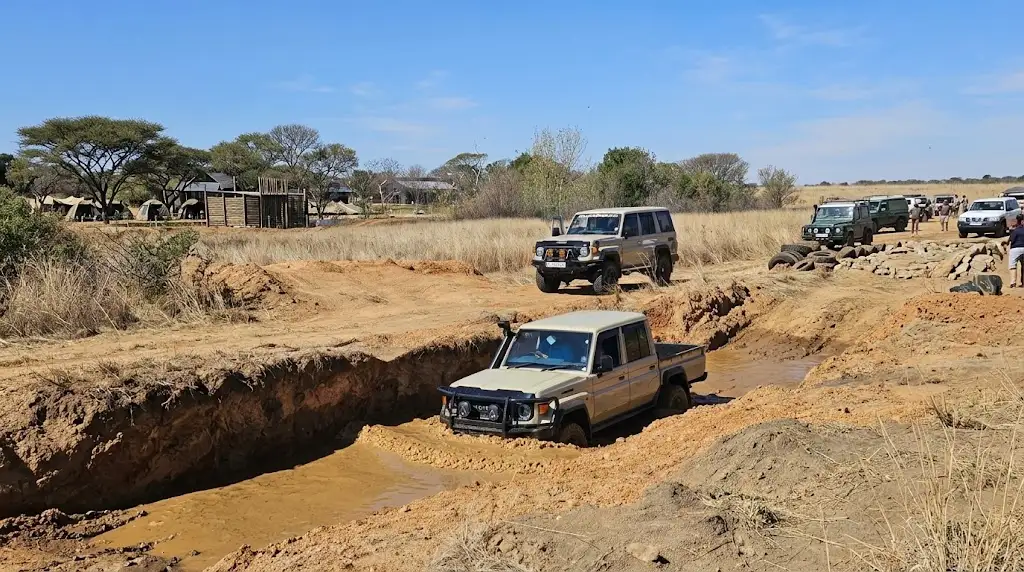
Choosing a Trail for a Family or Mixed-Experience Group
This is the case most trail websites don't help you with at all, and it's usually the one that matters most. If you're bringing a partner, kids, or friends who aren't interested in off-roading, the trail's grading is only half the decision. The other half is what happens to everyone else while the driver is out on the trail.
At a single-purpose trail, the honest answer is usually that they wait in a parking area, sometimes for a couple of hours. That's a fine trade-off if everyone in your group genuinely wants to be out there. It's a much harder sell if half your group would rather be doing something else.
This is where we'd point you directly to what makes Syringa Park different for this specific situation. Syringa Park's own graded 4x4 trail sits inside a wider property at Avianto Estate, so while you're on the trail, the rest of your group has somewhere real to be. Kids can spend hours at the MiFitness play park, there's a relaxed coffee to be had at Africa Black Coffee, and once you're done driving, the Syringa Pavilion has thirteen food vendors and licensed bars to bring everyone back together. If fishing is more some of your group's speed, our trout farm is on the same property too. It's a genuinely different day out than dropping your family at a trailhead with nothing to do but wait.
Choosing a Trail for a Corporate Day or Club Outing
Corporate days and club outings have their own set of needs, and grading is usually the smallest part of the decision. What matters more is whether the venue can handle a group booking, whether there's a facility for briefings or team building, and whether there's food and drink on-site so the day doesn't end the moment the driving does.
Look for venues that explicitly offer training sessions or events by prior arrangement rather than only fixed weekend trail access, since a corporate group often needs a specific day and time rather than whatever slot happens to be open. Syringa Park's own graded 4x4 trail offers training sessions and events any day of the week by prior arrangement, alongside weekend trail access, which tends to suit club and corporate bookings better than a venue only open Saturdays and Sundays. Get in touch with Terence on 083 601 7511 or Dawie on 079 504 7120 to talk through group bookings and current rates.
Distance, Price, and What Else There Is to Do
Once you've matched grading to your driving experience and worked out what your group actually needs, distance and price become the easy part. Most Gauteng trails cluster either northwest around Muldersdrift and Krugersdorp, or north around Pretoria and Hartbeespoort, so pick the cluster closer to where you're actually starting from.
Pricing varies more than most people expect, some venues charge a flat rate per vehicle, others charge per person on top of an entry fee, and a few don't publish pricing at all, which means a phone call before you commit. It's worth asking not just the price, but what it includes, whether that's a second passenger, recovery services, or braai and picnic facilities for afterward.
Frequently Asked Questions